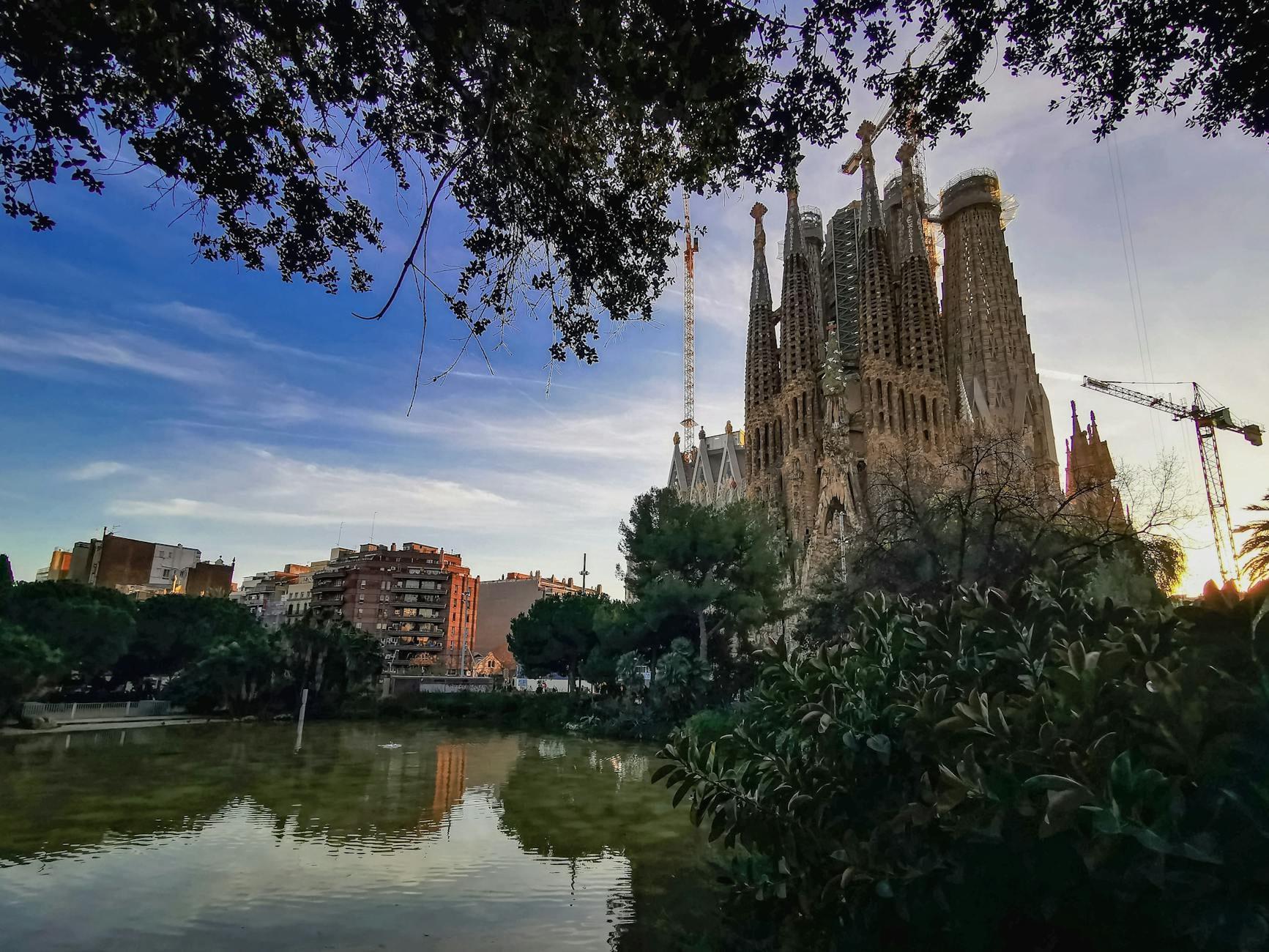
Technically called the Basilica and Expiatory Church of the Holy Family, this Roman Catholic church instead goes by the mafia-esque moniker Sagrada Familia. The building design was primarily the vision of architect Antoni Gaudi. Though since its groundbreaking in 1882 the structure has been under construction intermittently, with a major (and understandable), interruption for the Spanish Civil War. Construction is now estimated to be complete around 2026, but tourism here is actively encouraged as the primary funding source for the ongoing project.
While it can safely be regarded as striking, the range of opinion on Sagrada Familia’s appearance runs the gamut from spectacular and beautiful to, according to George Orwell, hideous. Regardless of one's opinion, the church currently draws about 2.5 million tourists per year. While still under construction, this functioning church is technically a basilica rather than a cathedral, since no bishop is seated there.
The exterior of the church's plan features three dominant themes in the form of the buildings facades. The first façade was completed in Gaudi's lifetime but the last remains incomplete still. Together these themes and the overall building, itself, are meant to represent and interpret the life of Christ. The three facades symbolize three periods of Jesus' life, the Nativity, the Glory, and the Passion. The fourth face of the building--technically the apse façade dedicated to the Mother Mary--will not be stressed in the manner of the three primary facades.
The Nativity Façade is dedicated to Jesus’ birth and contains a representation of the tree of life. It is also ornately decorated with human and other natural figures in three porticos representing faith, hope, and charity. The four towers topping the façade are dedicated to four saints, Matthias, Barnabas, Jude, and Simon the Zealot.
Drastically contrasting the ornate nature of the Nativity Façade, the Passion edifice is starkly plain in its simplicity. Its intentional austerity was meant to portray human sins and Jesus' suffering for those sins.
The construction on the final façade was only begun in 2002 and it remains mostly incomplete. But it is intended to be the most dramatic and largest of the facades. It is planned to include representations of hell, purgatory, false gods, idols, and demons, as well as both the seven deadly sins and the seven heavenly virtues. Dedicated to Jesus' celestial glory, it is meant to present the path to God.
As dramatic as the exterior of this building is, the interior may be even more striking. Inside are combinations of sharp pointed forms and smooth curves in abstract shapes. The effect is stunningly different from most any other church you’ve ever been in, and one you won’t soon forget.