ExploretheGo.lifeConnect
Log inSign up
theGo.lifeCarpe the Diem.
ResourcesTermsPrivacy
thego.life
Potala Palace hero
← Life list
Culture

Potala Palace

Sign up to track this →

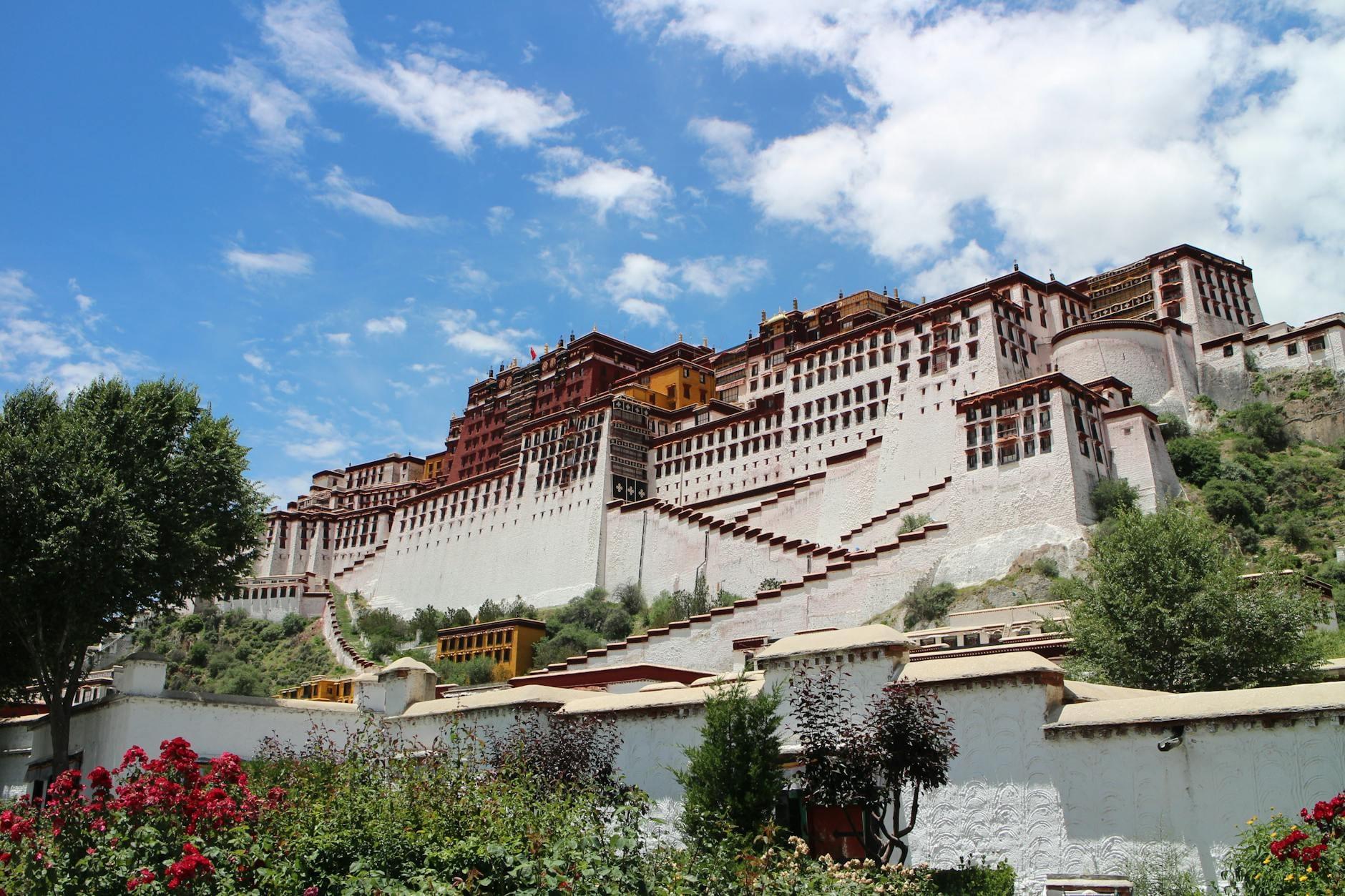
Impressively beautiful in both its structure and its stunning location, Potala Palace is, almost literally, a gold mine. It consists of several linked structures, most prominently the Red Palace and the White Palace. The imposing structures are at an altitude of over 12,000 feet, and stand 384 feet above the top of Red Mountain, with the striking drop of about 1,000 feet to the valley below. Built in 1645 at the behest of the 5th Dalai Lama as a seat of government, Potala was expanded in the 1690s and again in the early 1900s by the 13th Dalai Lama.

The White Palace was used as the Dalai Lama's residence complete with a ceremonial throne room, audience hall, and personal quarters, while the Red Palace was designated for religious study and prayer. The Red Palace has since become the burial place of eight Dalai Lamas, in solid gold-encased enclosures, called stupas. The stupa of the Fifth Dalai Lama alone is said to be coated with over 8,000 pounds of solid gold and is studded with thousands of pearls and jewels.

The palace contains a staggering number of artifacts of priceless value. There are nearly 10,000 painted scrolls and almost 700 murals. There are thousands of items including statuary, sculptures, fabrics, and many ornamental objects made of precious metals, porcelain, and jade. The entire structure is now a secular museum, and inside the Red Palace you will tour a maze-like structure of halls, chapels, galleries, and libraries.

While the 13th Dalai Lama was interred at Potala Palace--the first since the 9th Dalai Lama to be laid to rest there--it is unlikely that today's (14th) Dalai Lama will be. Living in exile, he is not favored by the Chinese government that has taken over Tibet, and he has abdicated all political authority to a democratically selected set of officials, also living in exile. Today's Dalai Lama has even suggested that his religious role should cease to exist when he dies, which would make the potential use of Potala Palace extremely unlikely as a future religious center, even if Tibet were to gain its independence from China.

While this marvelous location is now a museum, it is located in Tibet and retains religious significance. So certain religious taboos must be observed. No photographs are allowed inside, and upon entering you are not supposed to step on the threshold. Conservative clothing is advised and you are not permitted to wear a hat in the palace. Due to the extreme height, altitude sickness medication is also a wise preparation.

Where it is
China landscape
Potala Palace
China
Lhasa, Tibet
More culture
Acropolis
Greece
Angkor Wat
Cambodia
Aya Sofya
Turkey
Big Ben
England