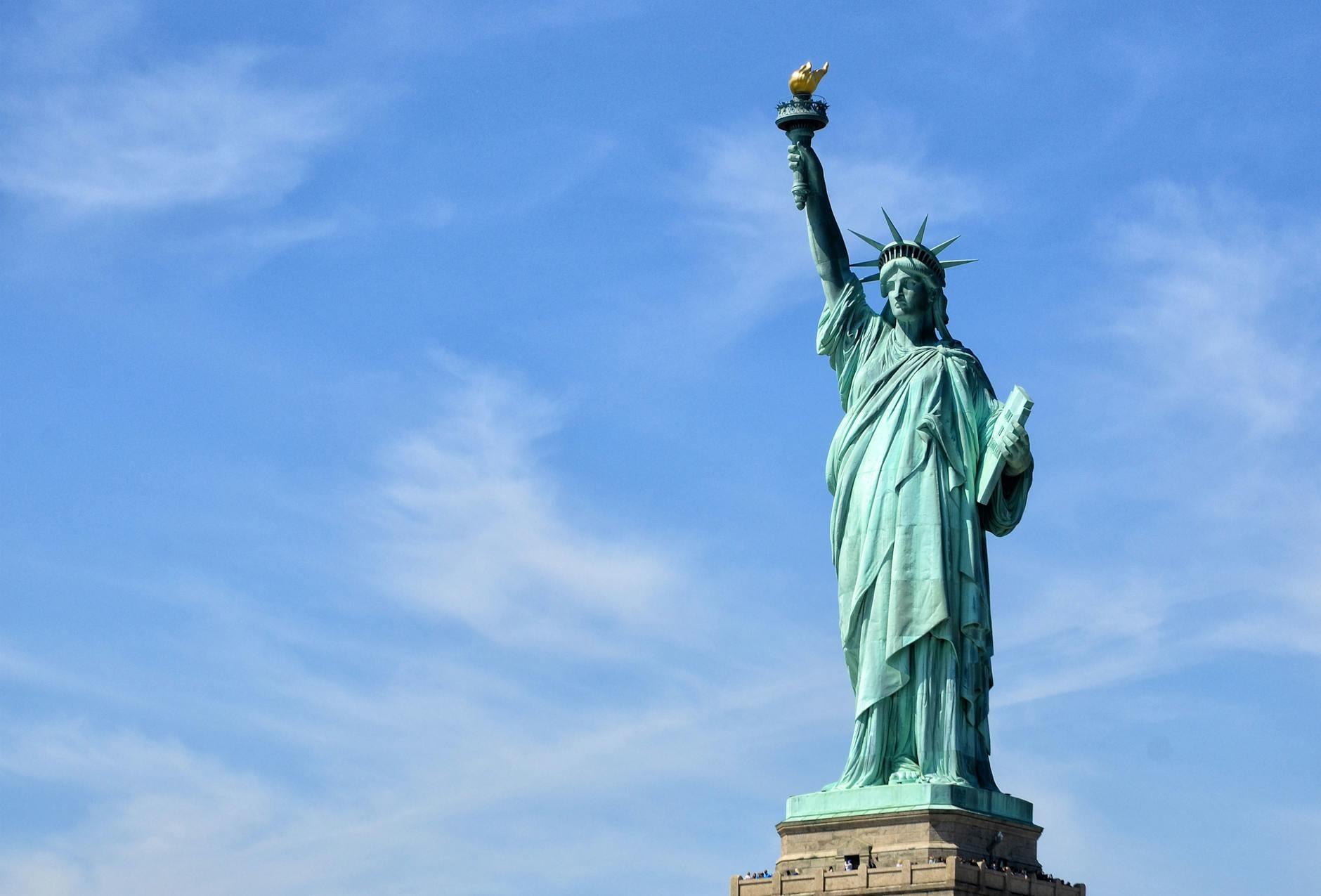
What icon stands more proudly for American freedom than the Statue of Liberty? Nevermind the fact that the poem at the monuments base: "...Give me your tired, your poor. Your huddled masses yearning to breathe free..." has since been scratched out and replaced with “Let’s build a fence.” The statue, formally titled Liberty Enlightening the World, has graced the harbor entrance to New York City since 1886.
A gift from the people of France, America's oldest ally, she towers above small Liberty Island. The statue alone stands just over 150' tall, but including the pedestal, from ground level to the top of her torch, Lady Liberty is over 305' tall. The statue's superficial skin is copper, hand formed with hammers in sections that were fitted together to an internal support structure.
The statue's designer was the French sculptor Frederic Auguste Bartholdi. Beyond freedom, Bartholdi wanted his figure to convey a peaceful dignity as well as reverence for the rule of law and an "enlightening" of the world with the concept of liberty. Toward these ends he modeled his masterpiece after the Roman Goddess of Freedom, Libertas, dressed in long flowing robes and holding a book and a torch. The torch, as well as the seven rays emanating from her head, represent the enlightening of the world. However, they also have other meanings. The torch signifies progress. The rays represent the seven continents, the seven seas, and of course the ultimate light of our world, the sun. The book is inscribed with the date of the signing of the Declaration of Independence, and at the foot of the statue, just visible beneath her robe is a broken chain signifying her breaking free from oppression.
Just as America today is plagued with divisive elements, so it was in the beginning. This marvelous gift from the French had difficulty gaining traction with Americans at first. The idea did not become a reality for eleven years due to financing difficulties. The just-ended Civil War left the coffers dry as well as leaving many in doubt about the unity that others craved and the statue embodied. There were questions about why America should even accept this gift from another country instead of creating its own monument to freedom.
The French had offered a statue that would require a pedestal, but they would not be sending the pedestal--the Americans would have to be responsible for that. And construction of the foundation and pedestal was not going to be cheap. Enter the enterprising and clever newspaper man Joseph Pulitzer of The New York World, who advertised that he would publish the name of every contributor to the project, no matter how small the donation. People from all walks of life sent in what they could and the pedestal construction proceeded. A kindergarten class sent in a donation of $1.35. At the project's conclusion, the newspaper announced that it had raised $102,000, and that 80 percent of the donations had been for less than one dollar. It was the world’s first successful kickstarter campaign.
At the dedication ceremony for the monument, a parade snaked through downtown New York and an--assumedly lazy--janitor decided to throw some ticker tape out the window of the New York Stock Exchange toward the parade passing below. Others litterers quickly joined in, and thus was born the tradition of the tickertape parade.
Today the statue can be toured up to the crown, although the extended arm and torch are no longer accessible for safety reasons. Also be sure to tour the Immigration Museum on nearby Ellis Island. Here you can find genealogy resources for names of those who immigrated through Ellis Island.